SiMDex
Mining Similar Egocentric Videos for
Cross-Embodiment Dexterous Manipulation
1The University of Tokyo
2ByteDance Seed
3The University of Hong Kong
4Shanghai Jiao Tong University
5Tsinghua University
Mining Similar Egocentric Videos for
Cross-Embodiment Dexterous Manipulation
Demo
Abstract
Recent years have witnessed an explosive trend of scaling ego-centric human videos for robot manipulation, yet it remains unclear which data actually benefits dexterous manipulation. We present SiMDex, a Similarity-based data Mining framework that casts human data selection for VLA post-training in Dexterous manipulation as a recommendation problem. For each robot demonstration, SiMDex employs a three-layer recall–ranking–re-ranking pipeline to extract task-relevant subsets from a pool of ~32M egocentric human samples, operating in a morphology-agnostic action space that requires no changes to VLA architecture or training. Against a strong baseline trained with an equal amount of randomly sampled human data, SiMDex uses only ~1.49M mined samples (<5% of the pool) yet improves the overall success rate from 47.7% to 61.1%—showing that selective curation outperforms indiscriminate data mixing.
Method
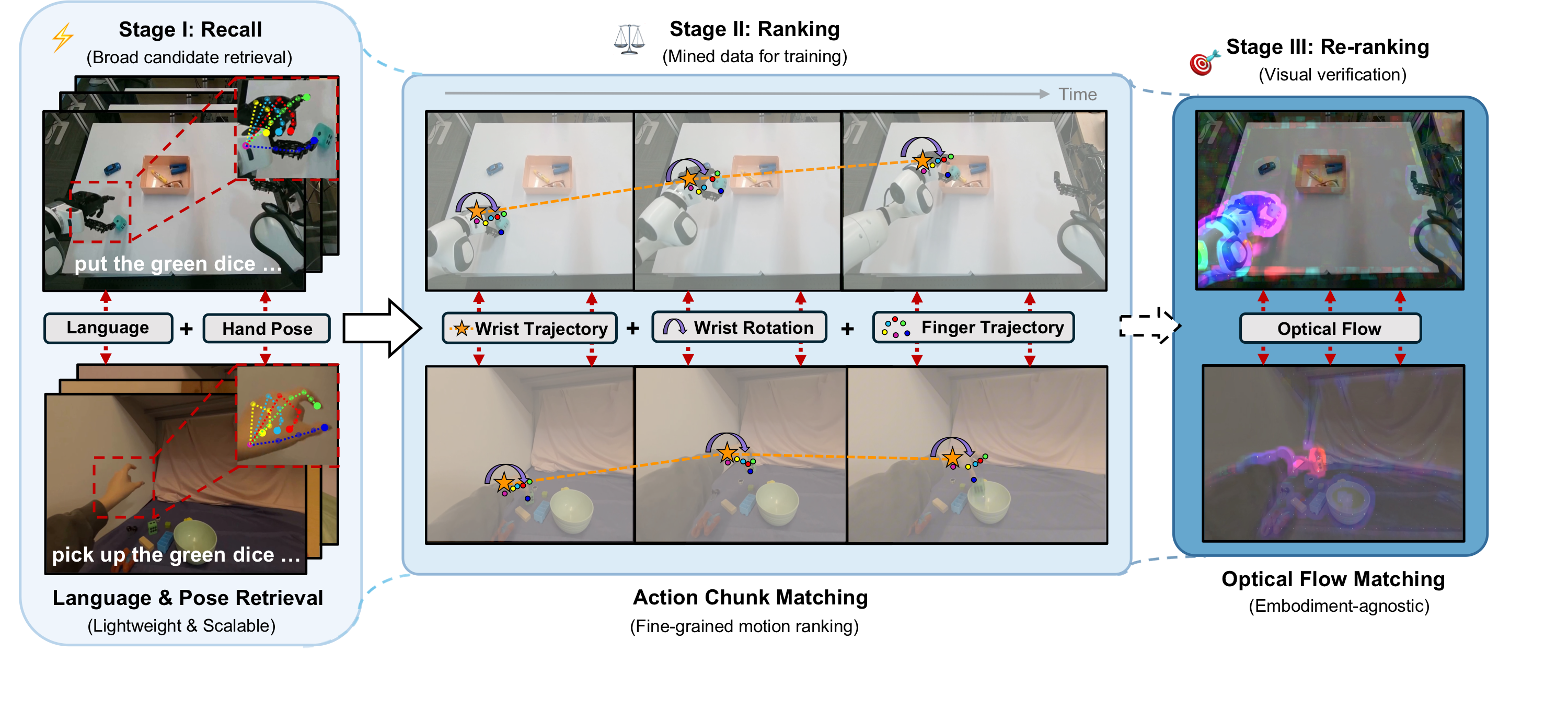
SiMDex mines the human demonstrations most similar to each robot demonstration — from a pool of tens of millions — through a three-stage cascade of increasing precision and cost.
Mining Human Demonstrations
Evaluation
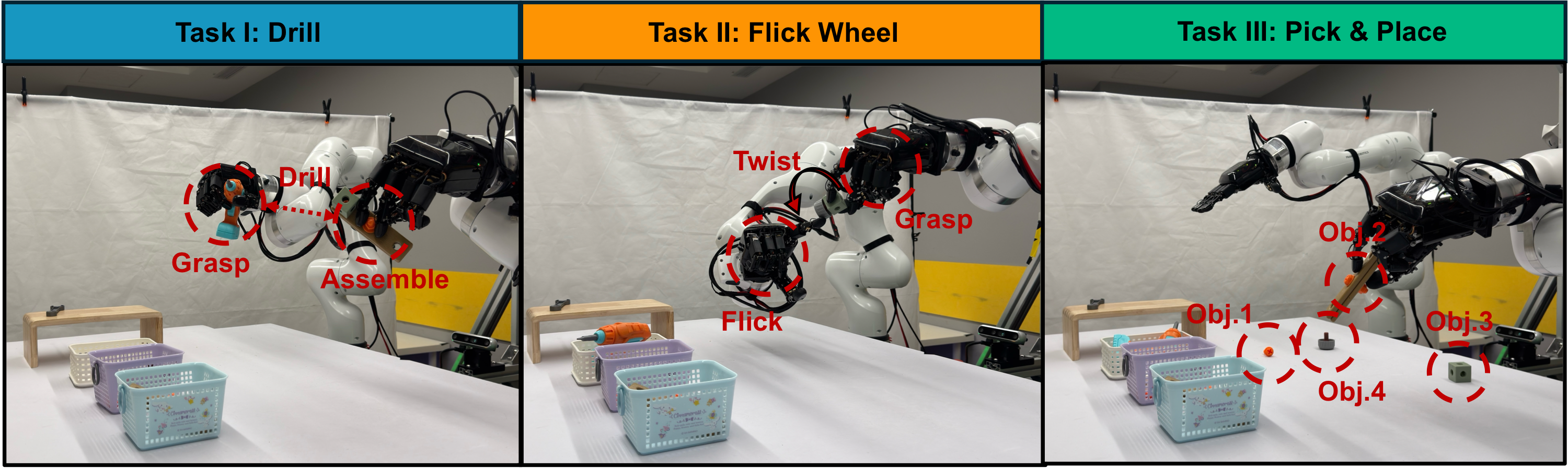
We design three real-world dexterous tasks as our evaluation suite, each targeting a different capability — tool use, fine-grained finger dexterity, and multi-object generalization. Every task enforces a strict sequence: fail one stage and the rest is blocked.
Rather than scoring only final success, we grade each stage separately — a fine-grained breakdown that reveals where an improvement comes from and gives a more three-dimensional picture of a robot's dexterity.
Tools Introduction
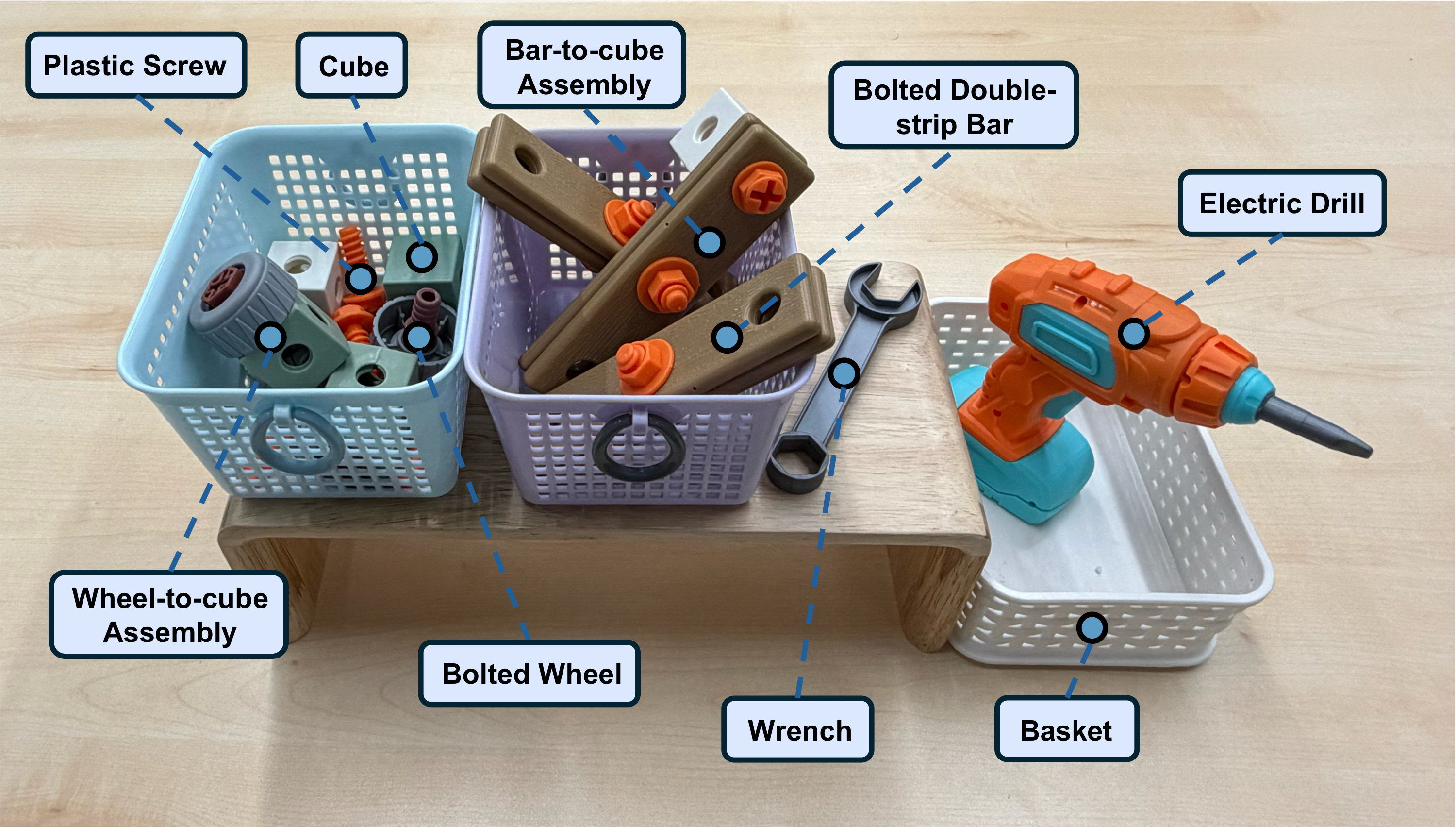
All tasks are performed on physical objects. The workspace includes interactive tools (an electric drill, a wrench), modular assembly parts (bolted bars, wheels, cubes, and plastic screws), and baskets for pick-and-place targets. Their varied geometries and tight tolerances demand the kind of fine-grained, contact-rich manipulation that low-DoF grippers cannot handle — and that makes them a faithful testbed for dexterous skill.
Teleoperation
Experiments
Main Results
Ablation Study
Rollout
Side-by-side comparison of GR-Dexter and SiMDex executing the same task. Choose a task and camera view to explore.
Takeaways
Still a long road ahead. SiMDex is an early step toward robots that acquire new skills by retrieving human experience — not a finished solution. Much remains to be done.
Citation
If your research involves human data selection, cross-embodiment learning, or dexterous manipulation, please consider citing SiMDex:
@article{lin2026simdex,
  title={SiMDex: Mining Similar Egocentric Videos for Cross-Embodiment Dexterous Manipulation},
  author={Lin, Nie and Ohkawa, Takehiko and Chen, Sijin and Wen, Ruoshi and Li, Zhuohang and Huang, Liqun and Zhu, Zhengming and Bao, Yiming and Li, Yunfei and Cai, Minjie and Ma, Xiao and Xu, Wei and Sato, Yoichi},
  journal={arXiv preprint arXiv:2608.04196},
  year={2026}
}
The core insight of SiMDex — mining the most similar human demonstrations for learning — was first introduced in SiMHand (ICLR 2025). If your work touches on hand pose estimation, learning from human video, or similarity-based data curation, please also consider citing:
@inproceedings{lin2025simhand,
  title={Simhand: Mining similar hands for large-scale 3d hand pose pre-training},
  author={Lin, Nie and Ohkawa, Takehiko and Huang, Yifei and Zhang, Mingfang and Cai, Minjie and Li, Ming and Furuta, Ryosuke and Sato, Yoichi},
  booktitle={International Conference on Learning Representations},
  volume={2025},
  pages={35662--35680},
  year={2025}
}
Acknowledgement
We thank the Bytedance Seed team for their generous support of the dexterous manipulation platform used in this project and for validating my key ideas. We also thank all co-authors for their insightful discussions throughout the development of SiMDex.